Introduction
This brief aims to explore and analyze the developments and factors affecting the state of conflicts in Sudan during November. This brief details the security events of October 2024 in Sudan, reviewing the rates of increase and decrease in forms of violence and their victims compared to October
Overview
This brief details security events in Sudan for November 2024 and reviews the rates of increase and decrease in forms of violence and their victims compared to October. In October, 274 violent incidents were observed. The violence is divided into basic types, each with several sub-types, including:
- Air Attack/Explosion: Airstrikes (fighter plane, helicopter, or drone), artillery bombardment, explosion, unknown explosion; 111 incidents.
- Armed Conflict: battles, raids, ambushes; 38 incidents.
- Violence Against Civilians: intentional killing of civilians, sexual assault/rape, kidnapping/captivity, torture, physical assault, forced detention, and looting; 124 incidents.
- Cross-Border Violence: a violent event that involves a foreign armed actor against any Sudanese actor; one incident.
Figure (1)
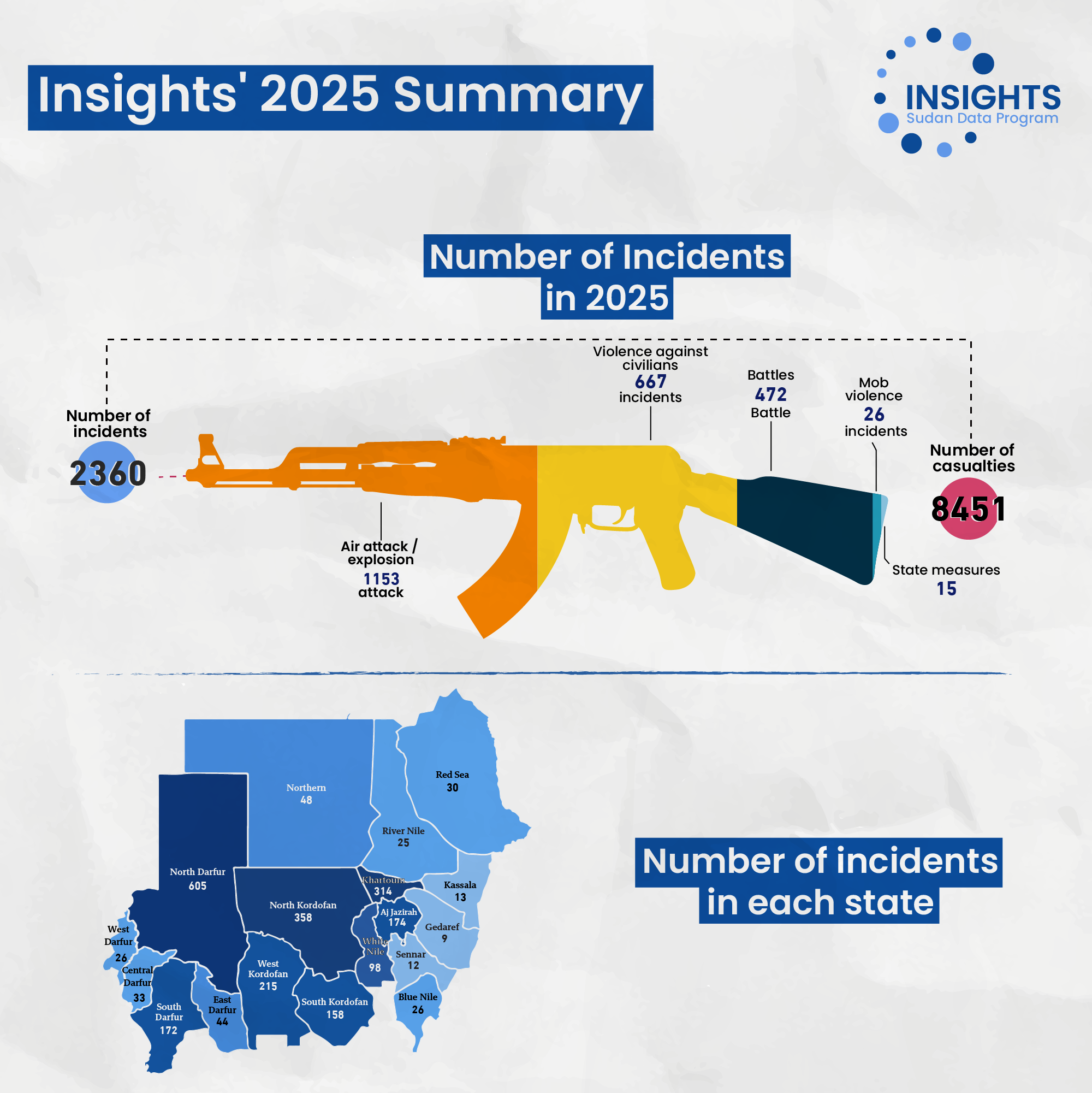
Figure (2) depicts the distribution of conflict types and sub-types in the different states of Sudan in November 2024.
Figure (2) shows types and sub-types of violence in the states of Sudan during November.
Click on a pattern to see the distribution of event sub-types.
Use the filter at the top-left of the figure to select sub-types.
Armed Conflict
Insights defines armed conflict as a confrontation between two parties, armed and occurring at a specific time and place. These parties may include government forces or organized armed groups with defined agendas, identities, or political goals, utilizing weapons to advance their objectives.
In November, there were 38 armed conflicts, resulting in 17 casualties. The majority of these incidents occurred in Khartoum (19 incidents) and North Darfur (10 incidents).
Looking at the sub-types, we observed 37 battles and one ambush in November, as shown in Figure (3). Figure (2) illustrates the distribution of these incidents across the various states of Sudan.
Figure (3)
Air Attack/Explosion
Insights defines an air attack/explosion as an airstrike (fighter plane, helicopter, drone), artillery, bomb, or any other explosive weapon targeting residential areas, enemy centers, or supplies. Such incidents typically involve a one-sided attack but can occasionally be mutual. Both armed actors and civilians can be the targets of an air attack or explosion.
There were 111 air attack/explosion incidents in 10 different states, resulting in 179 fatalities. The majority of these incidents occurred in North Darfur (46 incidents) and Khartoum (36 incidents).
Upon examining the sub-types, we observed 73 airstrikes, 38 incidents of artillery shelling, and one explosion – Figure (3). The distribution of these incidents across the different states of Sudan can be seen in Figure (2).
Violence Against Civilians
Insights defines violence against civilians as intentional violent incidents perpetrated by organized entities targeting civilians. Civilians, in this context, are people who are unarmed and not participating in organized violence. Perpetrators of violence against civilians may include government forces, rebels, militias, and foreign armed groups.
124 incidents of violence against civilians were monitored in 12 different states, leaving 326 fatalities. The majority of these incidents were concentrated in al-Jazeera state (75 incidents).
it is observed that in November, a total of 74 incidents of intentional killing of civilians, 27 incidents of looting, 9 incidents of kidnapping/captivity, 5 incidents of forced detention, 3 incidents of torture, 2 incidents of physical assault, and 2 incidents of sexual assault/rape were recorded
Referring to Figure (2), the distribution of these incidents in the different states of Sudan can be seen.
Casualties in November
Figure (4) illustrates the deadliest attack, which took place on October 25 when the Rapid Support Forces (RSF) raided as-Seraiha village in East al-Jazeera locality, killing 140 civilians. The second deadliest incident occurred on October 20 in Abu Shoka area of Sinja locality, Sinnar State, where RSF killed 120 people. On the same day, another RSF assault in Kutum locality, North Darfur, left 72 people dead. Sources indicate that both October 20 attacks were ethnically motivated.
Figure (4) illustrates that the deadliest attack occurred between November 20 and 21, when the RSF assaulted the village of Wad Esheib in the East al-Jazeera locality, resulting in the deaths of 42 civilians. The second deadliest attack took place on November 11, also in the East al-Jazeera, when the RSF targeted the village of as-Segai’a, claiming 30 civilian lives. Lastly, on November 9, South Darfur State experienced a third fatal event, when the SAF’s air force bombed the city of Nyala, killing 22 civilians.
Figure (4)
Violence incidents and casualties compared to October
Violence incidents
- Figure (5) shows the increase in security incidents in November (274) compared to October (408).
- November saw a notable decline in incidents of violence against civilians, with 124 incidents recorded compared to 155 in October. However, despite this overall decrease, violations in al-Jazeera State, which accounted for 60.5% of the total, saw only a slight reduction. In November, 75 violations were reported, compared to 81 in October.
- The number of airstrike/explosion incidents in November saw a significant decrease, dropping to 111 compared to 169 in October. This reduction was primarily driven by a marked decline in attacks targeting Khartoum, where airstrikes/explosions accounted for 56.2% of the total incidents in October. Attacks on Khartoum decreased from 95 in October to 36 in November. In contrast, there was little change in North Darfur, with 43 incidents recorded in October and 46 in November, indicating stable levels of aerial violence in the state.
- The number of armed conflict incidents saw a significant decrease in November, with only 38 incidents recorded compared to 81 in October. This decline can primarily be attributed to a reduction in the frequency of fighting in Khartoum, which experienced 45 battles in October, compared to 19 in November. Additionally, Sinnar and West Kordofan also witnessed a slight decrease in the number of battles, further contributing to the overall reduction in the frequency of armed conflicts.
Figure (5)
Figure (6) illustrates a significant decrease in the number of victims in November, with the total dropping to 523, compared to 1,149 victims in October, thus returning to levels seen prior to October. This sharp decline can be attributed to several key factors, including a notable reduction in the number of victims from intentional killings of civilians in al-Jazeera State, which decreased from 405 victims in October to 205 in November. This reduction is particularly evident in East al-Jazeera, an area previously subjected to a brutal revenge campaign by the RSF following the defection of their former commander, Abu Agla Keikal, to the SAF. Despite this improvement, East al-Jazeera remains one of the areas most affected by intentional killing of civilians.
Additionally, the number of victims of airstrikes in Khartoum decreased dramatically, from 51 in October to 7 in November, reflecting a reduction in the intensity of these attacks in the capital. Sinnar State also saw a marked improvement, with intentional killing of civilians dropping from 126 to 17, and no casualties from airstrikes in November, compared to 43 in October. North Darfur similarly experienced improvements, with airstrike casualties falling from 83 in October to 58 in November, and casualties from artillery shelling dropping from 88 to 48 during the same period, indicating a relative improvement in the overall security situation compared to the previous month.
Figure (6)
Summary
In November 2024, Sudan experienced a significant reduction in both the frequency of violence and casualty levels compared to October. A total of 274 incidents of violence were recorded, including 111 incidents of airstrikes/explosions, 38 incidents of armed conflict, 124 incidents of violence against civilians, and one incident of cross-border violence.
Overall, the number of security incidents declined in November, with incidents of violence against civilians decreasing to 124 from 155 in October. Violations in al-Jazeera State saw a slight reduction, though the state continues to account for the largest proportion of such incidents. Airstrike/explosion incidents also dropped significantly, from 169 in October to 111 in November, primarily due to a decline in attacks on Khartoum. Meanwhile, armed conflict incidents fell to 38 from 81 in October, largely driven by reduced fighting in Khartoum, Sinnar, and West Kordofan.
This decline in violence was mirrored in the number of casualties, which dropped to 523 in November, compared to 1,149 in October, bringing casualty levels back to their pre-October average. The decrease can be attributed to a reduction in intentional killing of civilians in al-Jazeera, a decline in airstrikes in Khartoum, and significant improvements in Sinnar and North Darfur. Overall, the reduction in both violence and casualties in November reflects a relative improvement in the security situation compared to the severe events witnessed in October.