Intorduction
This brief breaks down the conflict and security events in January 2024 in Sudan and reviews the increase and decrease rates in violence types and their victims compared to December. 383 violent incidents were monitored during January; classified into eight sub-types, their distribution in Sudan states and casualties are detailed in this brief.
Overview
In January, approximately 383 violence incidents were monitored; and categorized into eight basic types:
- Air attacks/explosions, include: Air strikes (fighter plane, helicopter, or drone), artillery bombardment, explosion, and unidentified remote explosion; 254 incidents.
- Armed conflicts, include: battles, raids, and ambushes; 78 incidents.
- Violence against civilians, include: intentional killing of civilians, sexual assault/rape, kidnapping/captivity, torture, physical assault, forced detention, and looting; 34 incidents.
- State measures, include: weapons control, arrests, security measures, and military action; 5 incidents.
- Violence against the state, include: assault on state officials, assault on state property; 4 incidents.
- Mob violence, include: mob clash and mob attack; one incident.
- Cross-border attack: one incident.
- Other incidents: 6 incidents.
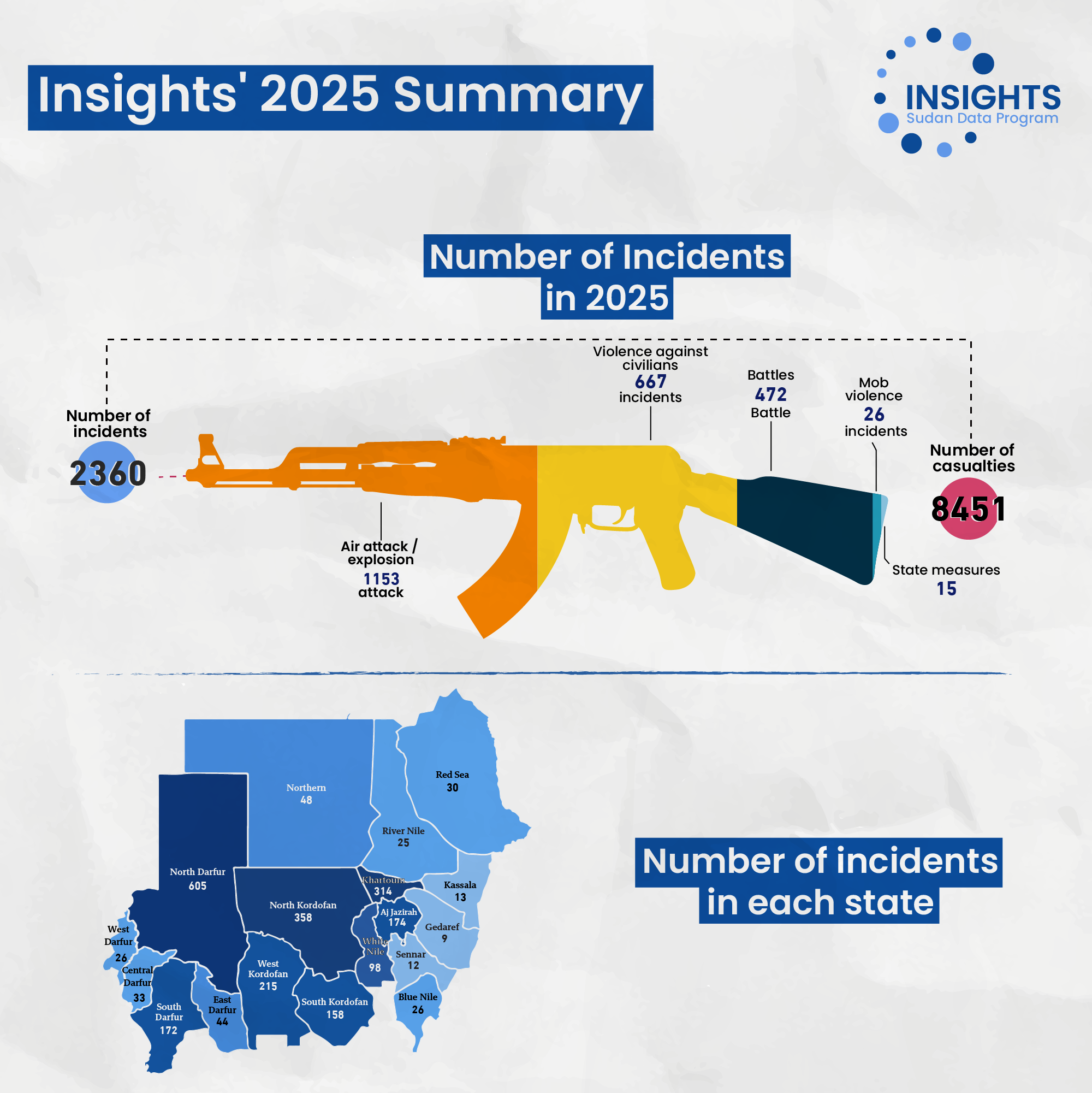
Figure (1) shows the number of events in January.
Figure (2)
How to read Figure (2): for optimal understanding, the team recommends the following:
- The figure shows the distribution of violent event types in the states, to see the distribution of subtypes, click on the violent event type (for example: by clicking on Armed clash events in Khartoum; the figure shows the event sub-types in Khartoum ). If you want to go back to events types click on the arrow at the top right of the figure.
- At the top left side of the figure, there is a (filter) that allows seeing the distribution of events by sub-events
Armed Conflict
Insights defines armed conflict as an armed clash between two parties at a specific time and place. The parties to the clash are required to be armed, and they could be government forces or organized armed groups with an agenda, identity, or political goals that use weapons to achieve them.
The number of Armed Conflict incidents reached 78 in January, resulting in 64 casualties; these incidents occurred in the following states:
- Khartoum; 48 incidents.
- West Kordofan; 8 incidents.
- North Darfur; 5 incidents.
- North Kordofan; 4 incidents.
- Al-Qadarif; 3 incidents.
- Sinnar; 2 incidents.
- Al-Jazeera; 2 incidents.
- River Nile; one incident.
- South Darfur; one incident.
Looking at the sub-types, we find that in January 76 battles and two ambushes were monitored – Figure (3). Figure (2) illustrates their distribution Sudan states.
Figure (3)
Air attacks/ explosions
Insights defines an air attack / explosion as an attack via a fighter plane, helicopter, drone, artillery, bomb or any other explosive weapon on a residential area, or enemy centers or supplies. An air attack/explosion incident is often a one-sided attack, but can sometimes be a mutual attack. Both armed actors and civilians can be the target of an air attack or explosion.
The number of Air Attacks / Explosions incidents in January was about 254 incidents distributed in 13 different states, leaving 174 victims.
- Khartoum; 189 incidents.
- Al-Jazeera; 22 incidents.
- West Kordofan; 18 incidents.
- South Kordofan; 6 incidents.
- South Darfur; 6 incidents.
- River Nile; 3 incidents.
- Sinnar; 2 incidents.
- White Nile; 2 incidents.
- West Darfur; 2 incidents.
- East Darfur; one incident.
- North Darfur; one incident.
- North Kordofan; one incident.
- Al-Qadarif; one incident.
Looking at the sub-types, we find that January had 124 incidents of artillery attack; 122 of Fighter jet / Helicopter/ drone strike; and one unidentified remote explosion – Figure (3). Figure (2) illustrates how these incidents were distributed in the different states of Sudan.
Casualties in January
Figure (4) shows that the incident that caused the largest number of casualties was on January 27, when gunmen attacked Abyei area, killing 50 civilians. The Sudanese Armed Forces (SAF)’s artillery and aerial attacks in Soba and as-Salama -Rapid Support Forces (RSF)-controlled areas- also left a total of 36 civilian casualties on January 11. This was not the first time that SAF aircrafts shell Soba area; aerial shelling on January 9 left 18 civilian deaths. Also, clashes between SAF and RSF in Babanusa locality of West Kordofan state on January 14 caused 16 civilian casualties.
It is also noted that the number of victims had increased in West Kordofan (123 victims) and al-Jazeera state (51 victims), but remained close in Khartoum maintaining a high level of victims (81) compared to December.
Figure (4)
Violence incidents and casualties compared to December
Violence Incidents
- Figure (6) shows the noticeable increase in the number of air attacks/explosions incidents, as their number rose to 254 incidents in January compared to 173 in December.
- The number of armed conflict incidents increased slightly in January, with 78 incidents compared to 61 in December.
- In contrast, January witnessed a decrease in State measures incidents; 5 incidents compared to 31 in December. Incidents of violence against civilians decreased to 34 incidents compared to 51 in December.
Figure (6)
Casualties
Figure (7) shows that the number of victims in January increased significantly compared to December, as 334 victims fell in January compared to 264 victims in December. This can be attributed to the increase in cases of violence monitored in January with 383 incidents, compared to 330 in December.
Figure (7)
Conclusion
In conclusion, we reiterate the importance of understanding and analyzing the current events in Sudan,to provide effective strategies to address the security and humanitarian challenges. The brief shows various violence types, requiring cooperation among the government, international community and NGOs.
The brief seeks to direct efforts towards raising awareness of the repercussions of violence, as well as help in achieving peace and stability in Sudan.