Introduction
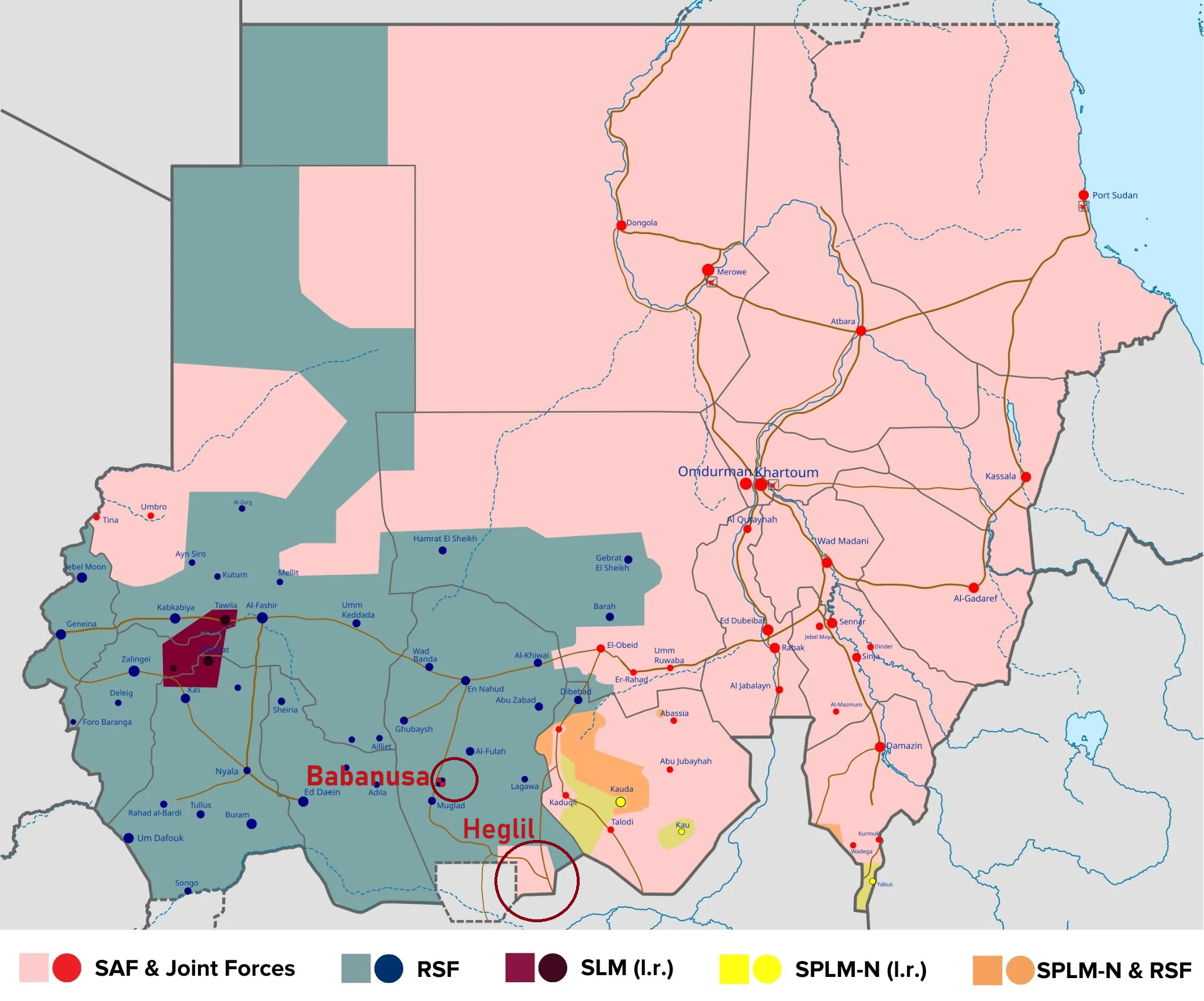
In its thirty-second month, and following the fall of Al-Fashir, the war has become increasingly confined to Kordofan region. The Sudanese Armed Forces (SAF) now hold control over the Nilotic and Eastern Sudan, while the Rapid Support Forces’ (RSF) administration and its allies consolidate the foundations of their rule in Darfur.
In North Kordofan, the fighting continues to shift back and forth without either side achieving decisive gains, while in West Kordofan the RSF have captured a major garrison for the second consecutive month. In South Kordofan, hostilities have resumed with greater intensity as the Sudan People’s Liberation Movement–North/Al-Hilu (SPLM-N/H) deepens its involvement—remaining the RSF’s most significant ally within the “Ta’sis” coalition.
Babanusa
On 1 December, the RSF succeeded in capturing the 22nd Infantry Division in the city of Babanusa—SAF’s most important stronghold in West Kordofan—after nearly two years of siege punctuated by intermittent rounds of fighting that intensified at times and subsided at others. With the fall of Babanusa, SAF’s presence in Kordofan has become confined to the oil-producing area of Heglig, bordering South Sudan.
In late November—and following the RSF’s takeover of Al-Fashir—the RSF deployed large military reinforcements toward Babanusa and launched its assault on the besieged 22nd Infantry Division (surrounded from January 2024 to December 2025) after four months of relative calm around the garrison. During the operation, the RSF intensified its artillery and drone strikes on SAF’s defenses, then carried out a series of ground attacks beginning on 24 November. On 1 December, the RSF announced it had taken control of the division’s headquarters, while SAF announced on 4 December that its withdrawing forces had reached Heglig.
It later emerged that some of the withdrawing troops had fallen into an RSF ambush, resulting in the death of Major General Muawiya Hamad, commander of the 22nd Division, his deputy, and the commanders of artillery and air defenses, in addition to a number of officers and soldiers.
The factors that led to the fall of Babanusa resemble those that preceded the fall of Al-Fasher: the garrison had been under prolonged siege and cut off from supplies, while the RSF deployed air defense systems that prevented SAF from providing air support and also prevented strikes on RSF build-ups around the city. The ground assault came after heavy artillery and drone bombardment that exhausted the SAF’s defenses, followed by continuous ground incursions.
However, Al-Fasher held out longer owing to the social element within the city, where large numbers of local youth fought alongside SAF—making RSF advances costly and difficult to sustain. Babanusa, by contrast, was almost entirely empty of civilians; in November, the Babanusa Emergency Room reported the displacement of around 177,000 people and the near-complete evacuation of the city. This reality was also linked to the tribal composition of the area’s population.
Babanusa and the Internal Composition of the RSF
The battles of Babanusa were fought in a city completely emptied of its population, after community leaders brokered an agreement in January 2024 between SAF and the RSF that established a temporary ceasefire allowing civilians to leave.
Beyond the humanitarian dimension, the presence of civilians in Babanusa — one of the main population centers of the Messeriya tribe — would have led to further involvement in the fighting and created sharp polarization within the same tribal group. The 22nd Infantry Division includes large numbers of Messeriya fighters across various ranks, among them prominent officers such as Brigadier Darmot, the division’s deputy commander; meanwhile, the Messeriya tribe is also one of the main pillars of the RSF, with a strong presence across its formations.
As the war dragged on and local communities became increasingly mobilized along tribal and ethnic lines, the position of Messeriya’s traditional leadership became clearer, showing a marked tilt toward the RSF. In November 2024, Mukhtar Babo Nimir, Paramount Chief of the Messeriya, declared his support for the RSF and pledged to provide 10,000 fighters. Another Messeriya community leader described the confrontation with SAF as an “existential battle,” expressing fears that SAF and its allies could commit genocide against tribes supporting the RSF if it were to regain control over Kordofan and Darfur.
This community alignment, combined with the prolonged siege on the 22nd Division, allowed the RSF leadership to postpone the battle for Babanusa and focus its military efforts on advancing toward and seizing Al-Fasher in North Darfur, as well as repelling SAF’s advance in North Kordofan.
Implications of the Fall of the 22nd Division
Babanusa is located in the heart of West Kordofan, approximately 170 kilometers from the disputed Abyei region and around 270 kilometers from the Heglig oil field, with one of South Sudan’s oil pipelines passing through the state. Babanusa was chosen in 2013 as the headquarters of the main military division in the state following the attack by the South Sudan People’s Army on Heglig, with the aim of securing oil sites and the southern border.
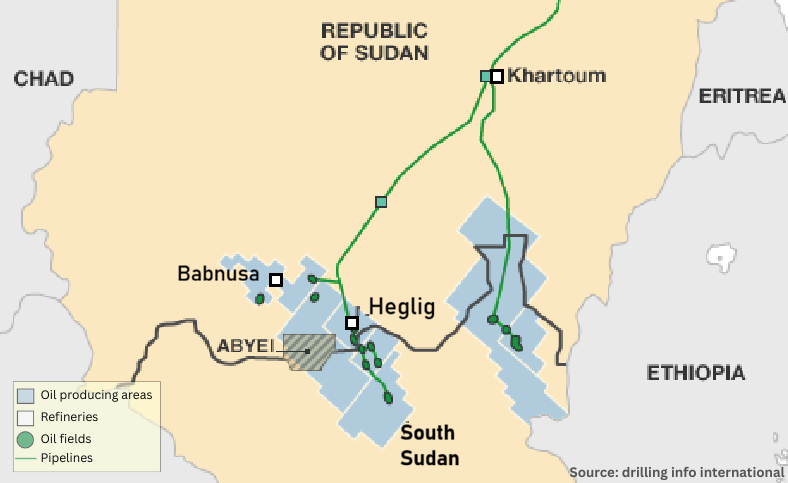
With the fall of the 22nd Infantry Division, the RSF now exercises near-complete control over West Kordofan, while the presence of the SAF is confined to the Heglig oil field—a presence not expected to last long according to military estimates. This control grants the RSF direct influence over the oil sector and transit routes, likely forcing the government of South Sudan to coordinate directly with them regarding oil, which accounts for approximately 90% of the country’s revenue.
The fall of Babanusa also represented a significant internal gain for the RSF, reassuring the leadership and bases of the Messeriya tribe that their key social and economic centers are under the control of their ally. Militarily, this development opens the door for the RSF, in coordination with the SPLM-N/H, to establish a new operational axis west of Kadugli, the largest city in South Kordofan and one of SAF’s most important positions in the state.
North Kordofan
North Kordofan witnessed a military escalation by SAF throughout November. On the first day of the month, SAF carried out airstrikes on Bara, Al-Khowei, Abu Zayd, An-Nahud, as well as Lagawa and Al-Fula in West Kordofan, with the aim of dispersing RSF units that had been massing to launch attacks in the northern part of the state, and to pave the way for subsequent ground operations.
On 3 November, SAF deployed new reinforcements toward Bara, where clashes erupted, enabling it to advance and impose a multi-front siege on the town. On 17 November, SAF and the Sudan Shield Forces (SSF) launched a coordinated operation in which they regained control of Bara for the second time — having first taken it in September before losing it again to the RSF in October — but later withdrew to avoid an encirclement by RSF forces. The RSF pursuit inflicted heavy losses on the SSF and resulted in the injury of their commander, Kaikel.
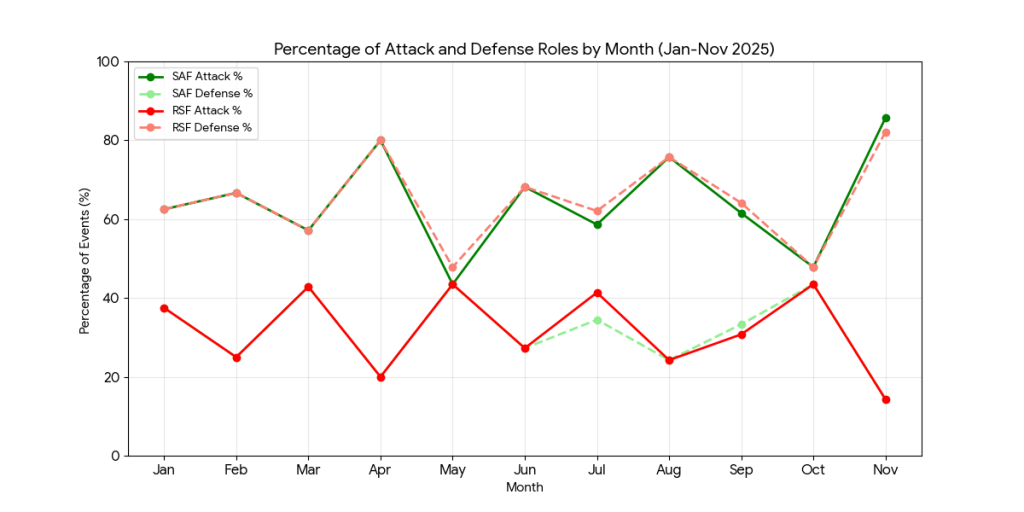
Since early 2025, North Kordofan has seen continuous battles with high human costs; hundreds of officers and soldiers have been killed each month, without either side achieving meaningful territorial gains. The state’s open terrain and sparse population also limit the strategic value of capturing and clearing towns. Holding territory in such an environment is costly and difficult under the fast-moving “Toyota war” style of fighting, in contrast to urban warfare in major cities such as Khartoum and Madani.
South Kordofan
After six months of relative calm, interrupted only by occasional skirmishes and shelling, fighting returned to South Kordofan with an attack by SPLM-N/H and the RSF on 27 November against the Kertala garrison, located between Abu Kershola and Dalanj. SAF successfully repelled the attack and held its positions in the area, before advancing in the following days to recapture the towns of Tabasa and Damra west of Al-Abbasia on 30 November, and to take control of Gardoud–Jama in Hebila locality, which had been under SPLM-N/H control since 2011.
Through these offensive operations, SAF aims to weaken SPLM-N/H to facilitate its campaigns in case it advances to lift the siege of the strategic towns of Dalanj and Kadugli in the state.
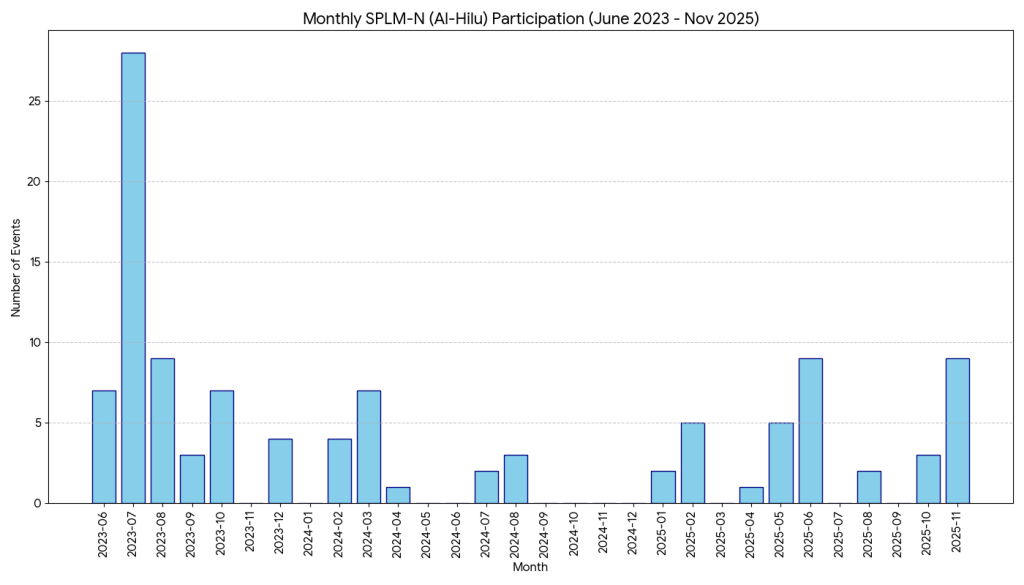
These movements by the SPLM-N/H also signal a deeper engagement in the war, especially following its alignment with the RSF and its joining of the Ta’sis coalition earlier in February 2025.
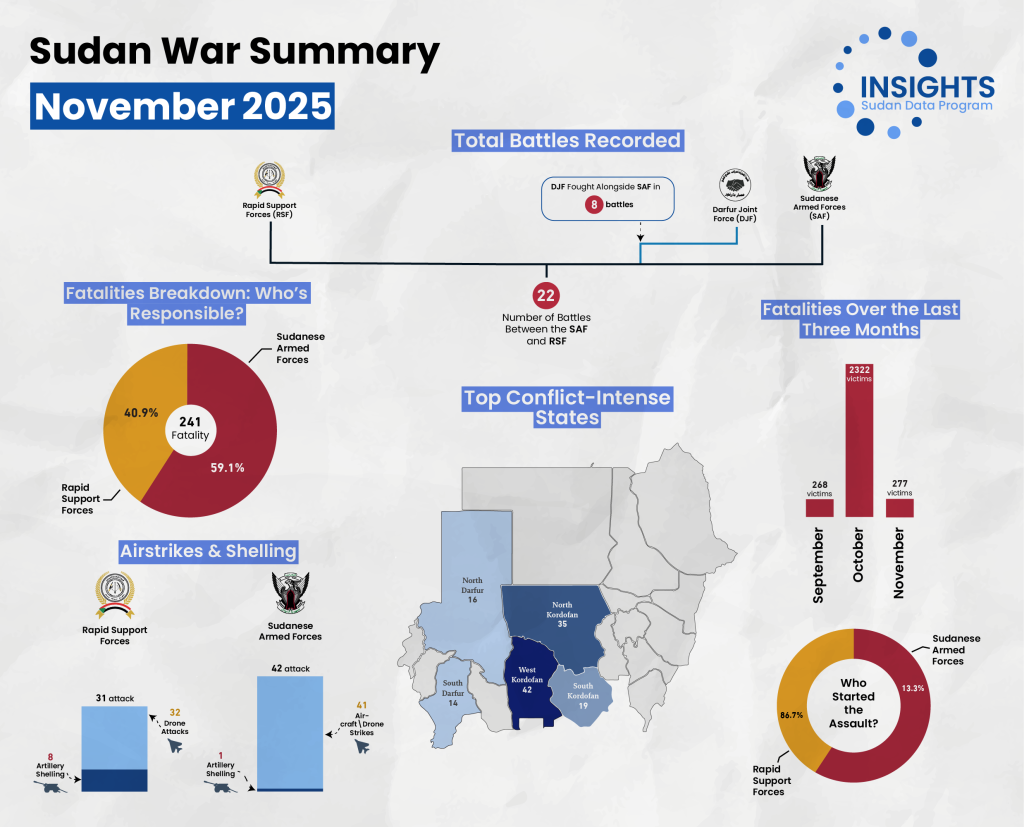
In November, multiple military fronts were activated across Kordofan, with clashes reported throughout the region’s three states. Notably, for the first time, operations occurred within SPLM-N/H strongholds in South Kordofan.
The escalation coincided with the end of the rainy season, which improved mobility across the plains, particularly in North and West Kordofan, enabling both sides to launch more effective attacks on each other’s positions.
By the end of the month, the RSF’s capture of Babanusa marked a significant step toward eliminating SAF’s presence in western and southwestern Sudan, strengthening internal cohesion among RSF forces, and enhancing leverage through control of territory along South Sudan’s oil pipeline.
Meanwhile, SAF remains engaged in attritional battles in North Kordofan, while the RSF and its SPLM-N/H ally concentrate their operations in South Kordofan, targeting the strategically isolated towns of Kadugli and Dalanj, which have been under siege for nearly two years, in a pattern similar to Al-Fasher and Babanusa prior to their fall.