Introduction
This brief aims to explore and analyze the developments and factors affecting the state of conflicts in Sudan during October. This brief details the security events of October 2024 in Sudan, reviewing the rates of increase and decrease in forms of violence and their victims compared to September.
Overview
In October, 408 violent incidents were observed. The violence is divided into basic types, each with several sub-types, including:
- Air Attack/Explosion: Airstrikes (fighter plane, helicopter, or drone), artillery bombardment, explosion, unknown explosion; 169 incidents.
- Armed Conflict: battles, raids, ambushes; 81 incidents.
- Violence Against Civilians: intentional killing of civilians, sexual assault/rape, kidnapping/captivity, torture, physical assault, forced detention, and looting; 155 incidents.
- State Measures: weapons control, arrests, security measures, and military action; three incidents.
Figure (1)
Figure (2)
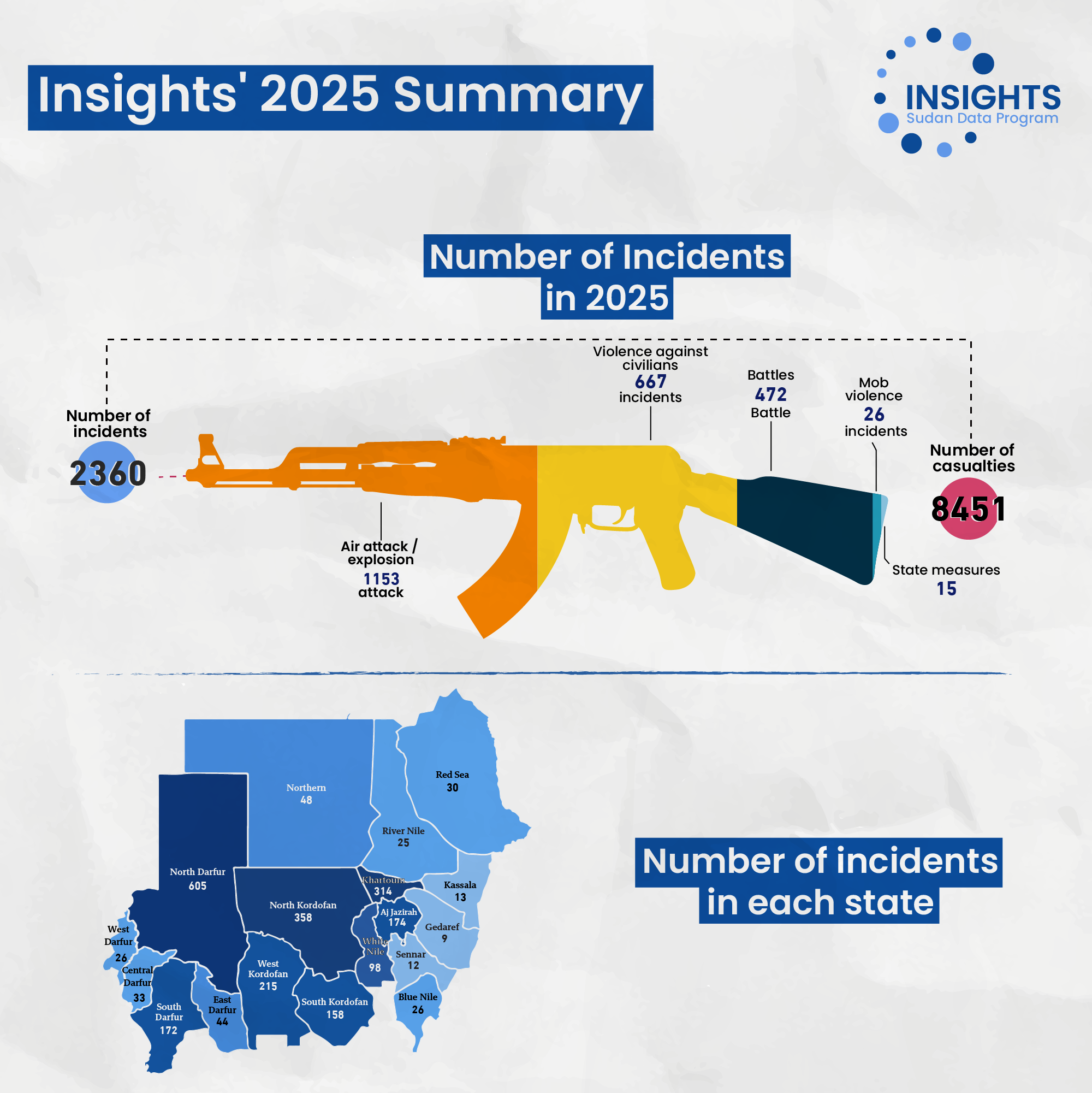
Figure (2) depicts the distribution of conflict types and sub-types in the different states of Sudan in October 2024.
Figure (2) shows types and sub-types of violence in the states of Sudan during October
Click on a pattern to see the distribution of event sub-types.
Use the filter at the top-left of the figure to select sub-types.
Armed Conflict
Insights defines armed conflict as a confrontation between two parties, armed and occurring at a specific time and place. These parties may include government forces or organized armed groups with defined agendas, identities, or political goals, utilizing weapons to advance their objectives.
In October, there were 81 armed conflicts, resulting in 12 casualties. The majority of these incidents occurred in Khartoum (45 incidents) and North Darfur (13 incidents).
Looking at the sub-types, we observed 81 battles in September, as shown in Figure (3). Figure (2) illustrates the distribution of these incidents across the various states of Sudan.
Figure (3)
Air Attack/Explosion
Insights defines an air attack/explosion as an airstrike (fighter plane, helicopter, drone), artillery, bomb, or any other explosive weapon targeting residential areas, enemy centers, or supplies. Such incidents typically involve a one-sided attack but can occasionally be mutual. Both armed actors and civilians can be the targets of an air attack or explosion.
There were 169 air attack/explosion incidents in 10 different states, resulting in 399 casualties. The majority of these incidents occurred in Khartoum (95 incidents) and North Darfur (43 incidents).
Upon examining the sub-types, we observed 95 airstrikes, 66 incidents of artillery shelling, seven explosions, and one unknown explosion – Figure (3). The distribution of these incidents across the different states of Sudan can be seen in Figure (2).
Violence Against Civilians
Insights defines violence against civilians as intentional violent incidents perpetrated by organized entities targeting civilians. Civilians, in this context, are people who are unarmed and not participating in organized violence. Perpetrators of violence against civilians may include government forces, rebels, militias, and foreign armed groups.
155 incidents of violence against civilians were monitored in 14 different states, leaving 738 fatalities. The majority of these incidents were concentrated in al-Jazeera state (81 incidents).
Looking at the sub-types, we found that there were 108 incidents of intentional killing of civilians, 21 incidents of forced detention, 10 incidents of physical assault, six incidents of kidnapping/captivity, and five incident of sexual assault/rape – Figure (3).
Referring to Figure (2), the distribution of these incidents in the different states of Sudan can be
Casualties in August
Figure (4) illustrates the deadliest attack, which took place on October 25 when the Rapid Support Forces (RSF) raided as-Seraiha village in East al-Jazeera locality, killing 140 civilians. The second deadliest incident occurred on October 20 in Abu Shoka area of Sinja locality, Sinnar State, where RSF killed 120 people. On the same day, another RSF assault in Kutum locality, North Darfur, left 72 people dead. Sources indicate that both October 20 attacks were ethnically motivated.
Figure (4)
Violence incidents and casualties compared to September
Violence incidents
- Figure (5) shows the increase in security incidents in October (408) compared to September (363).
- October saw a notable rise in violence against civilians, with 155 incidents recorded, up from 126 in September.
- The number of airstrike/explosion incidents slightly decreased in October, with 169 recorded, down from 179 in September.
- Armed conflict incidents saw a significant increase in October, with 81 recorded compared to 57 in September.
Figure (5)
Casualties
Figure (6) reveals a dramatic rise in casualties during October, which reached 1,149 compared to 616 in September. This increase is largely attributed to a surge in violence by the RSF in al-Jazeera State, where 467 casualties were reported, accounting for 40.6% of the total deaths in October. Most of the deaths in al-Jazeera resulted from violence against civilians, a spike believed to be linked to RSF assaults following the announcement by former RSF commander Abu Agla Keikal that he had defected to the Sudanese army (SAF). Notably, East al-Jazeera locality, which saw the highest number of casualties in October, had previously experienced relatively low levels of violence in earlier months compared to other areas in the state. This pattern suggests a direct connection between the escalation in violence and Keikal’s defection.
Figure (6)
Summary
October was the deadliest month since the war broke out in Sudan, marked by an unprecedented escalation in violence. A total of 408 violent incidents were recorded, with violence against civilians’ incidents spiking sharply. There were 155 attacks on civilians, most of them in al-Jazeera State. Airstrikes and armed clashes continued across various states, pushing the overall death toll to 1,149—an increase of 533 compared to September.
The deadliest attacks were concentrated in al-Jazeera State, where 467 people were killed in brutal assaults by the RSF following the defection of Abu Agla Keikal to the SAF. These attacks appear to be part of a targeted campaign against civilians, particularly in East al-Jazeera, an area that had previously experienced relatively low levels of violence.
The sharp rise in casualties in October highlights the rapidly deteriorating security situation and the growing suffering of civilians. It signals a significant shift in the nature of the conflict, underscoring the urgent need for measures to protect the population and advance peace efforts.