Introduction
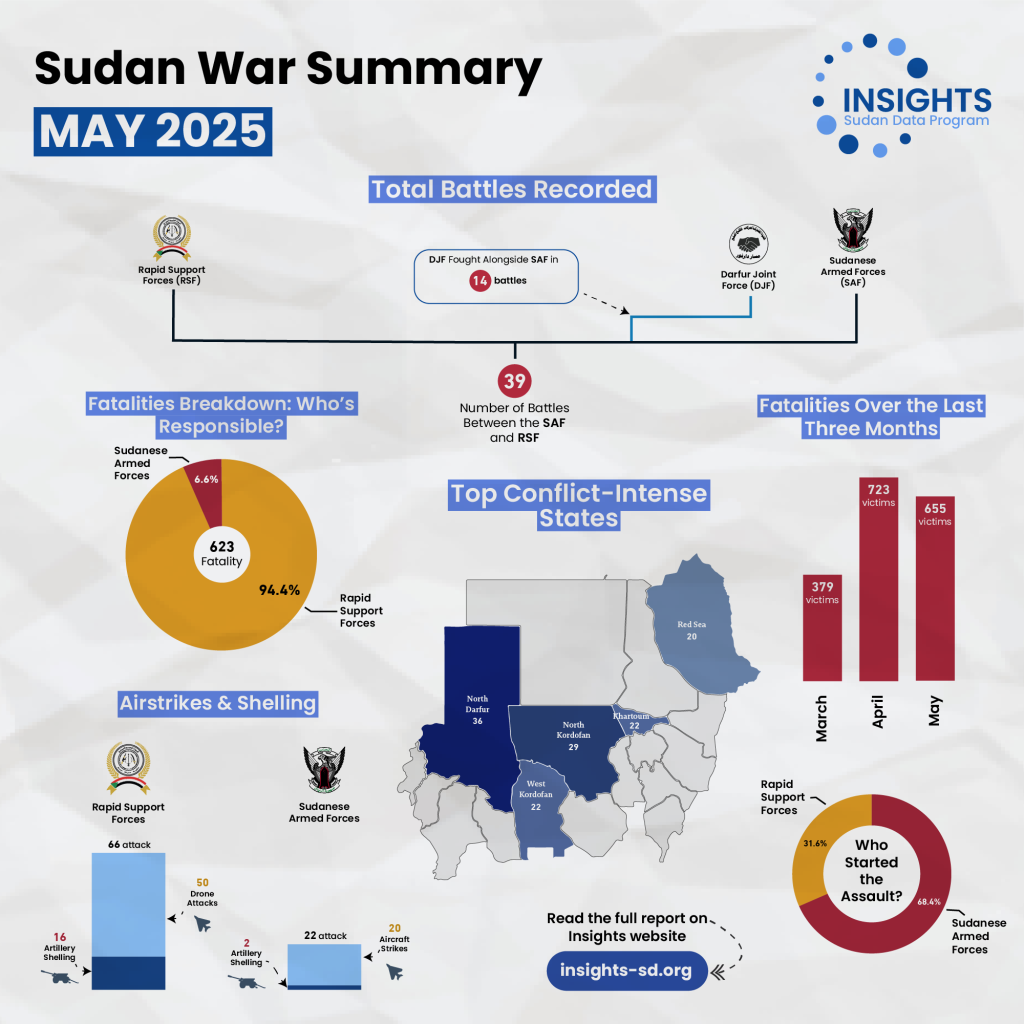
The Sudanese Armed Forces (SAF) resumed its offensive operations in Central Sudan, which began in September 2024 by crossing the bridges toward the cities of Khartoum and Bahri. In October, operations extended into Al-Jazeera State following the alignment of the Sudan Shield Forces (SSF) led by Abu Agla Keikal, leading to SAF’s full recapture of Al-Jazeera, followed by Khartoum and White Nile State in May.
The fighting then shifted to the Kordofan Region after Rapid Support Forces (RSF) retreated to North Kordofan, particularly the localities of Bara and Jabra ash-Sheikh. Both West and South Kordofan witnessed fierce clashes between SAF and RSF, with control of several towns changing hands. RSF mobilized reinforcements from Darfur and Kordofan in an effort to halt SAF’s westward advance toward Al-Fashir.
RSF appeared to prefer engaging in Kordofan, as Major General An-Nour Qubba—RSF’s fourth-in-command and leader of the offensive on Al-Fashir—was seen in Al-Khuwei. RSF also deployed reinforcements to areas including Abuzabad and Wad Banda. These movements followed statements by pro-SAF forces—SSF and al-Baraa ibn Malik Brigade—expressing intent to advance westward to “liberate” Darfur.
Kordofan Axis
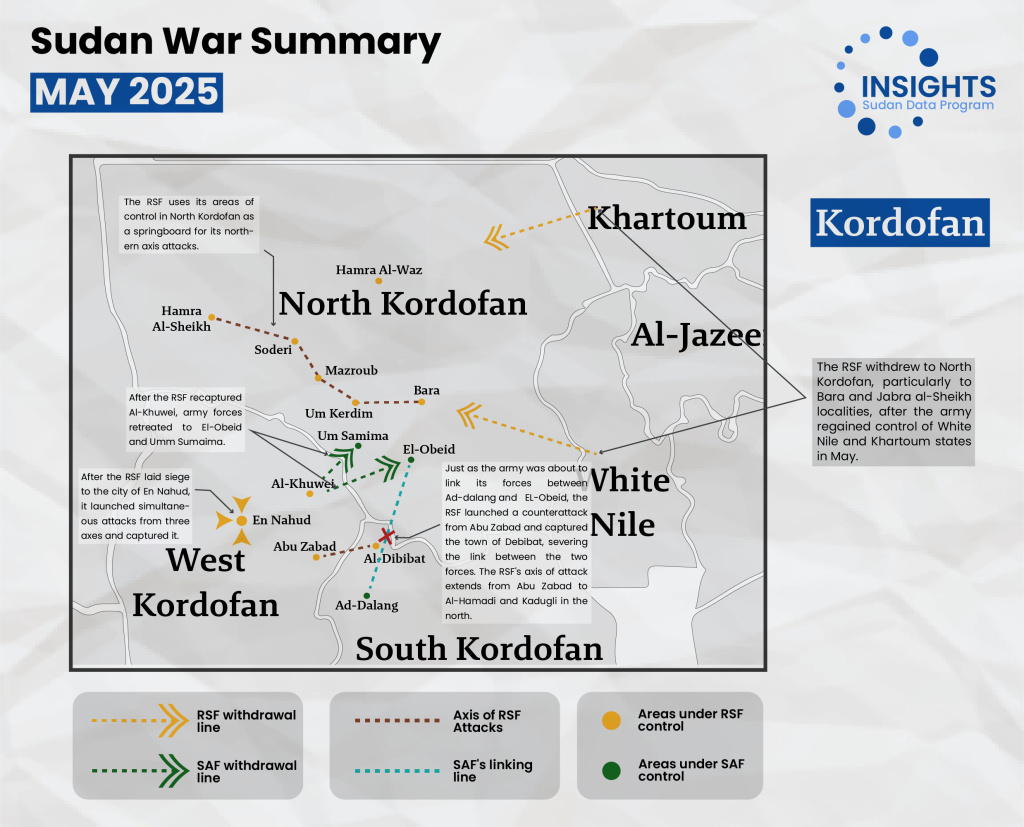
Kordofan Region, encompassing its three states, has witnessed continuous back-and-forth fighting and shifting control between SAF and RSF, especially in South and West Kordofan. RSF captured An-Nuhud and Al-Khuwei, before SAF launched a counterattack and regained western Sheikan, Al-Khuwei, and the areas of Al-Hammadi and Ad-Dibaybat in Al-Qoz locality, South Kordofan. RSF later regained most of the territories it lost in May.
Preparations for the RSF attack on An-Nuhud began early. In April, RSF took control of Umm Kadada in North Darfur—about 220 km west of An-Nuhud and home to the 24th Infantry Brigade—and sent reinforcements to Wad Banda, 71 km west of An-Nuhud.
In early May, RSF launched a three-pronged attack on An-Nuhud from the north, south, and west, capitalizing on its control over large parts of North and West Kordofan and eastern North Darfur, effectively imposing a near-total siege on the city.
SAF, supported by former armed struggle movements and local resistance groups (mostly from the Hamar tribe), repelled the first RSF attack. However, RSF regrouped and launched a second assault, capturing most of An-Nuhud and forcing SAF and its allies to retreat to the 18th Infantry Brigade command post, which later fell after their withdrawal to Al-Khuwei.
RSF then advanced eastward, occupying villages around An-Nuhud and entering Al-Khuwei, defeating SAF units that fled to Al-Ubayyid. RSF then moved into Sheikan locality, capturing areas west of Al-Ubayyid including Umm Sumayma (65 km west of the city) and Al-‘Ayyara (24 km west).
SAF responded with a counteroffensive through the Sayyad mobile unit, backed by joint forces from the armed struggle movements, Liwa’ al-Baraa ibn Malik, and local resistance. They retook Al-‘Ayyara, Umm Sumayma, and Al-Khuwei. However, RSF recaptured Al-Khuwei two weeks later, forcing SAF to retreat to Umm Sumayma, suffering heavy losses, including the death of the Sayyad commander.
South of Al-Ubayyid, SAF launched a ground offensive to break the southern siege, capturing Al-Ban Jadeed, Umm ‘Arda, and Kazgeel (40 km south of Al-Ubayyid), then advanced into Al-Qoz locality and recaptured Al-Hammadi and Ad-Dibaybat, which had been under RSF control since June 2023.
But as SAF neared linking Dalang with Al-Ubayyid, RSF launched a counterattack from Abuzabad, regaining control over Ad-Dibaybat, Al-Hammadi, all areas north of South Kordofan locality, and Kazgeel in Sheikan. SAF retreated to Umm ‘Arda (26 km south of Al-Ubayyid).
Western White Nile (South of Omdurman and North of White Nile State)
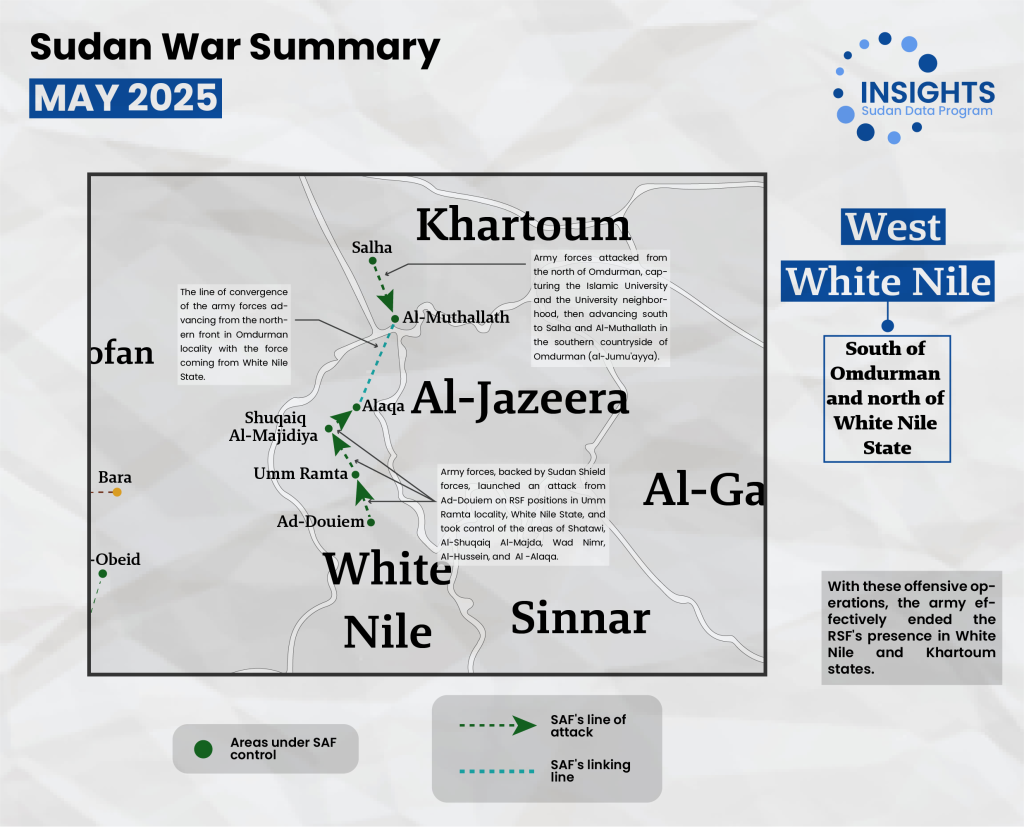
SAF launched a military operation from both northern and southern axes to recapture RSF-held areas in White Nile and Khartoum states. The operation culminated in RSF’s withdrawal to North Kordofan.
From the south, SAF units advanced from Ad-Dueim, supported by SSF led by Abu Agla Keikal, and attacked RSF positions in Umm Ramta locality, White Nile State. They seized Shtawi, Ash-Shiqayq al-Majida, Wad Nimir, and Al-Husayn, then continued to Al-‘Alqa, 90 km south of Omdurman.
From the north, SAF launched attacks on RSF in Omdurman locality, taking over the Islamic University buildings and then the adjacent neighborhood, before pushing south toward Salha and Al-Muthallath in Omdurman’s southern countryside (Al-Jumaiya area), where they met the southern front.
This operation effectively ended RSF’s presence in White Nile and Khartoum. Remaining RSF units retreated to North Kordofan, and several RSF commanders formerly based in South Omdurman were later seen in Bara, North Kordofan.
RSF Intensifies Drone Attacks
May witnessed a notable increase in RSF’s use of drones, targeting military positions and critical infrastructure in Red Sea, Kassala, Khartoum, White Nile, and North Kordofan states. Reports suggest RSF deployed more advanced attack drones than the suicide drones used in earlier strikes.
In Red Sea State, drones targeted Port Sudan Airport, destroying a fuel tank and sparking large fires that led to the airport’s evacuation and the suspension of all flights. Fuel depots and the city’s power station were also attacked, with fires raging for several days.
Other attacks targeted the Flamingo naval base, and containers at the main port in Port Sudan. Some sources claimed the strikes hit army arms and ammunition shipments, though SAF has not issued an official statement confirming or denying the allegations.
In Kassala, drones struck the city’s airport, though no casualties or damage were reported. RSF also bombed Omdurman, hitting three power substations and causing a multi-day blackout across most of Khartoum State.
In North Kordofan, RSF drones hit Al-Ubayyid’s refinery and prison, killing 21 people and injuring 47. In Kosti, White Nile State, drones targeted fuel depots near the river transport hub and the city’s security cell headquarters.
Conclusion
RSF is placing high strategic importance on operations in Kordofan, with high-ranking commanders and foreign fighters from the Central African Republic’s Seleka militias deployed there. RSF has moved from a defensive to offensive posture, regaining and expanding territorial control.
With its control of Al-Khuwei and successful efforts to push SAF back to Umm Sumayma and Umm ‘Arda, RSF now also controls Bara and parts of Ar-Rahad. This positions RSF for a potential three-front assault on Al-Ubayyid (from the north, south, and west). If RSF captures Al-Ubayyid, it would significantly consolidate its grip over western Sudan.